An official website of the United States government. Here's how you know.


 Countdown to




The East Coast Memorial is an American Battle Monuments Commission site dedicated to service members who lost their lives at sea in the American coastal waters during World War II. But do you know everything about it?
A memorial located in the heart of New York City
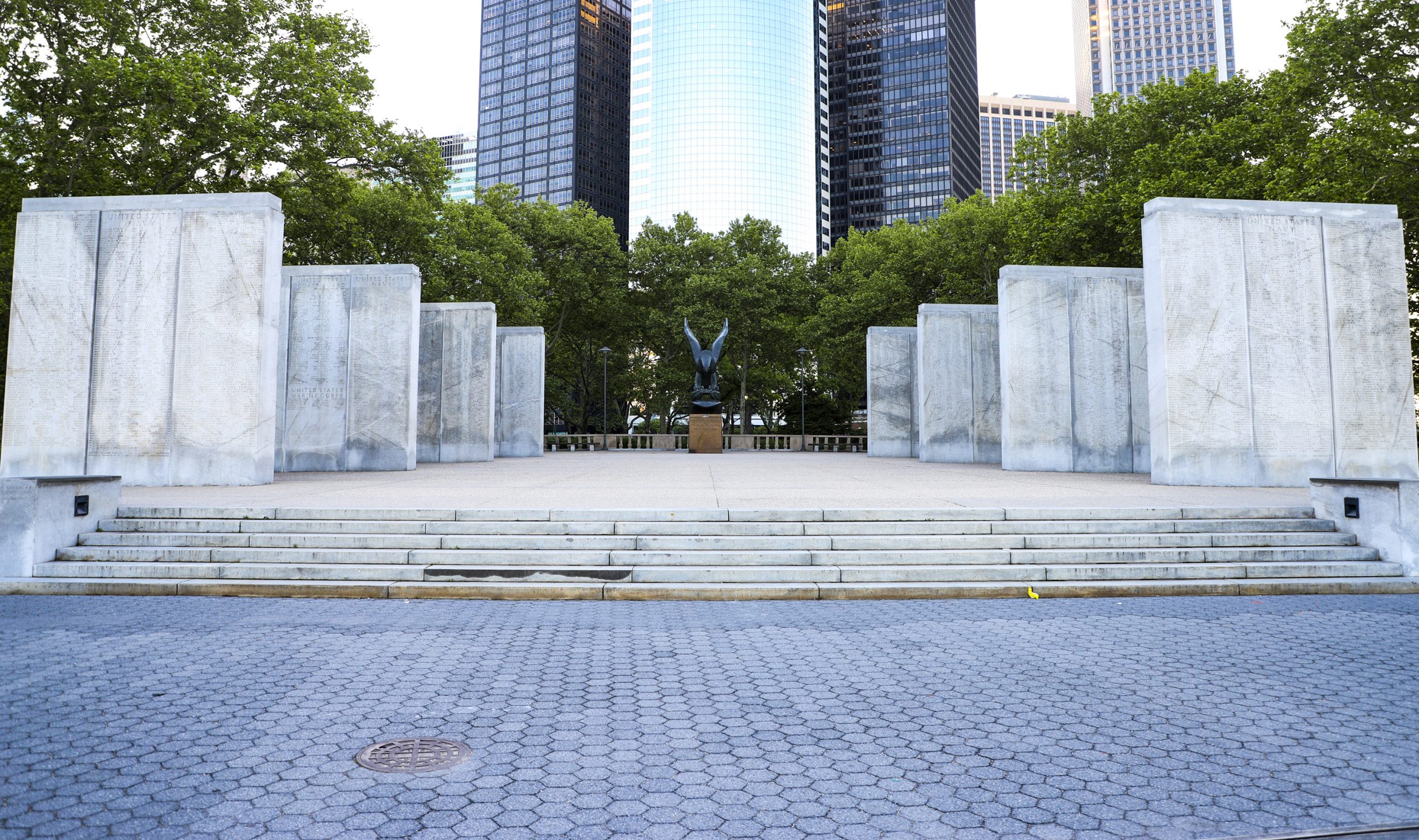
The East Coast Memorial is one of three American Battle Monuments Commission sites in the U.S. At the southern tip of Manhattan, overlooking New York Harbor, stands The Battery with the East Coast Memorial designed by William Gehron from Gehron & Seltzer of New York. The East Coast Memorial is composed of eight gray, granite pylons, four on each side of the center axis of the memorial, representing a bronze eagle. Surrounded by trees, the space is intentionally contemplative, despite sitting in one of the busiest transportation hubs in New York. It is dedicated to more than 4,600 American servicemen who were lost at sea during World War II.
Though millions of visitors pass through The Battery each year, many know little about the meaning and history behind this memorial. Beyond its visual presence, the East Coast Memorial carries stories and details that deepen our understanding of sacrifice during the Battle of the Atlantic in the American coastal waters.
One of the servicemen who never came back home is Seaman 1st Class Melvin R. Roland.
Roland was a 21-year-old Navy Armed Guard from Bentonville, Arkansas. He served aboard the SS James McKay, a merchant ship transporting supplies to Allied forces. While traveling in convoy HX-217 on the way to Belfast, Ireland, the McKay fell behind the group south of Iceland. On Dec. 8, 1942, the German submarine U-600 torpedoed the ship repeatedly. The McKay sank with 62 men on board, including Roland. His body was never recovered, and his name is engraved on the East Coast Memorial to honor his sacrifice.
A place to honor those who never came home
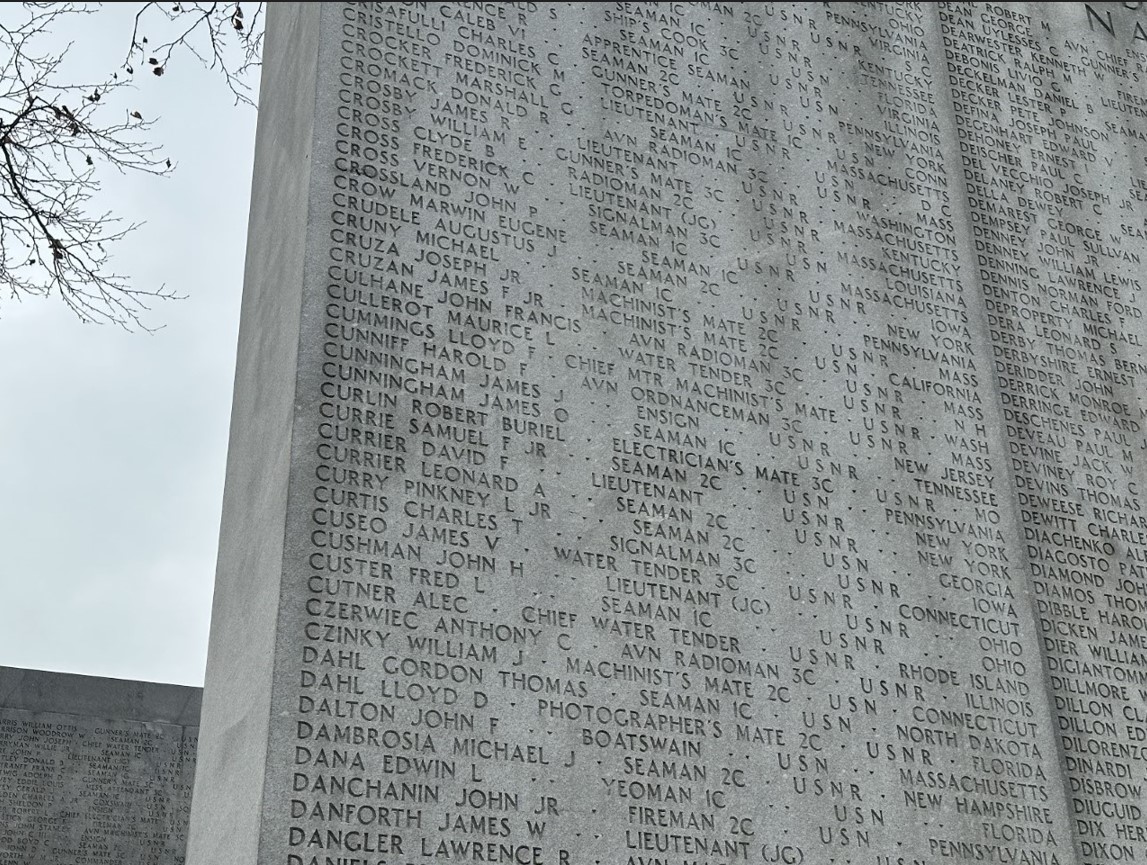
Unlike traditional military cemeteries, the East Coast Memorial is dedicated to men who never returned home. The names engraved into its eight pylons belong to soldiers, sailors, airmen, Marines, Coast Guardsmen and merchant mariners whose bodies were never recovered after being lost in the Atlantic. Many of the service members commemorated there died while escorting convoys across U-boat-infested-waters, battling storms, during collisions, or supporting aerial patrols over vast stretches of ocean.
This memorial functions as a symbolic gravesite, a sacred place for families who have nowhere else to mourn. Inscribed beneath the 18-feet-high bronze eagle are the words, “Erected by the United States of America in proud and grateful remembrance of her sons who gave their lives in her service and who sleep in the American coastal waters of the Atlantic Ocean. Into thy hands, O Lord.”
Electrician’s Mate 3rd Class Robert B. Curlin is also commemorated at the memorial. During World War II, Curlin was a 20-year-old fireman from Fulton, Kentucky, serving on the destroyer USS Jacob Jones (DD-130). After escorting several convoys in the North Atlantic, the Jones was assigned to a roving anti-submarine patrol to search for and sink enemy submarines wherever they could be found. On Feb. 28, 1942, the Jones was torpedoed by U-578 off Cape May. All but 11 of the crew were lost, including Curlin.
A symbol of freedom
The location and design of the memorial contain deliberate symbolism often unnoticed by visitors. The eight towering granite pylons form a ceremonial pathway, leading the eye across the harbor.
At the northern entrance stands a five-ton bronze eagle, sculpted by Albino Manca, lifting a laurel wreath as if ready to place it upon the sea in tribute to the fallen that forever rest in the water.
The East Coast Memorial’s central axis points directly towards the Statue of Liberty, located two miles to the south. This alignment reflects the profound connection between the service members who crossed the Atlantic to defend freedom and the monument that represents America’s ideals. As visitors walk the pathway between the pylons, they symbolically retrace the route so many service members took on their way to war.
President John F. Kennedy dedicated the East Coast Memorial May 23, 1963. It was the last site to be dedicated as part of the American Battle Monuments Commission World War II program.
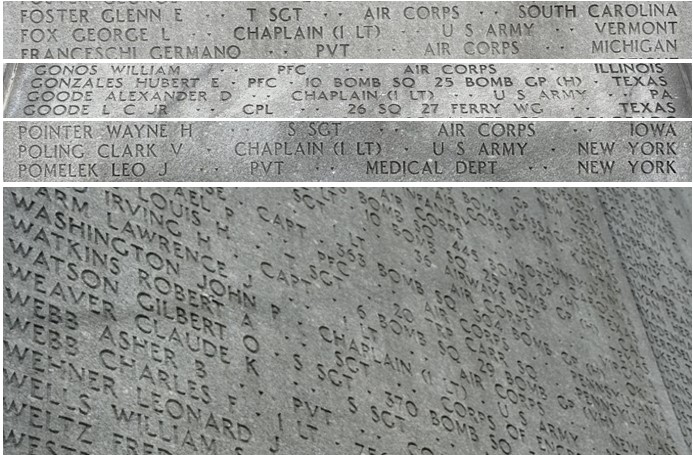
Among the names remembered at the East Coast Memorial are four U.S. Army chaplains: First Lt. George L. Fox, a Methodist minister from Vermont, 1st Lt. Alexander D. Goode, a Jewish rabbi from Pennsylvania, 1st Lt. Clark V Poling, a Reformed Church in America minister from New York, and 1st Lt. John P. Washington, a Roman Catholic priest from New Jersey. They all served aboard the troopship SS Dorchester. On Feb. 3. 1943, the ship was torpedoed by the German submarine U-223 in the icy waters of the Labrador Sea. With the vessel sinking rapidly and life jackets running out, the four chaplains gave up their own to save others. Survivors last saw them standing arm-in-arm, praying together as the ship went down. Of 904 people on board, 674 were lost, making it the deadliest single American convoy tragedy of the war. Their heroism became a symbol of selfless courage and unity across faiths.
The American Battle Monuments Commission sites are a constant reminder of Gen. John J. Pershing’s promise that, “time will not dim the glory of their deeds.”